Monteverde Coffee, Chocolate, and Night Tour Guide
You smell the roasted beans first, sharp and nutty in the cool mountain air, right before someone hands you a cracked wooden cup of warm, bittersweet chocolate. Booking a monteverde coffee chocolate and night tour usually starts as a practical decision to pack three activities into a single afternoon, but it turns out to be one of the most sensory evenings you can spend in Costa Rica. By the time total darkness settles over the hillside around 5:45 PM, the sweet taste of raw sugarcane is still on your tongue and your guide is already pointing a beam of light into the damp undergrowth.
Most travelers arrive in Santa Elena with a checklist: see the cloud forest, walk a suspension bridge, spot a resplendent quetzal. Yet agricultural life and wild biology collide constantly here. The cloud forest borders private family farms where shade-grown Arabica coffee thrives under banana plants and native trees. Combining agricultural harvesting, bean-to-bar chocolate making, and a guided night hike lets you understand both how humans live off this landscape and what creeps out of the canopy the moment the human workers leave.
Book your monteverde night tour experience:
What Happens on a Monteverde Coffee Chocolate and Night Tour
The standard combination tour begins around 2:30 or 3:00 PM. That gives you roughly two hours of daylight to explore the working fields before the sunset kicks off the nocturnal biology segment. It is an efficient schedule. You avoid paying for separate transfers back and forth from your hotel, which saves roughly $25 to $30 in taxi fares alone on these steep, pitted dirt roads.
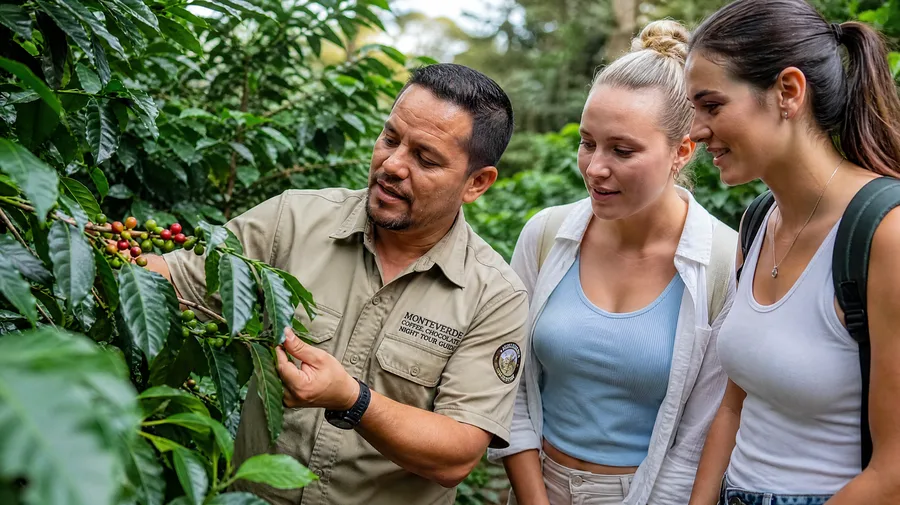
First comes the coffee field. Monteverde sits between 1,200 and 1,450 meters above sea level, an ideal elevation for hard-bean Arabica. You walk between the waist-high bushes while a guide explains picking seasons, the difference between red and yellow cherries, and the sheer physical toll of harvest time, which runs roughly from November through February. If you visit mid-harvest, you will actually pick a handful of ripe cherries yourself, squeeze out the sweet, slimy pulp inside, and spit the seeds.
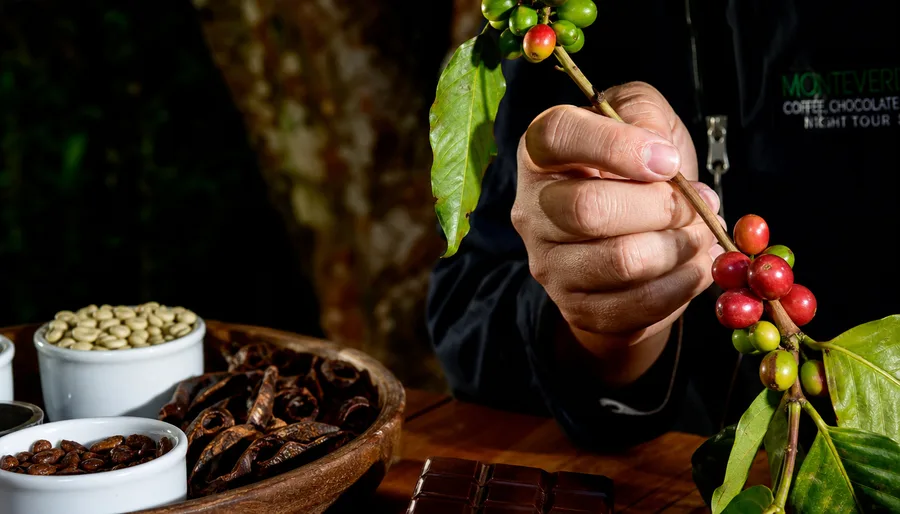
Next is the processing mill - the beneficio. Here you see how the beans are de-pulped, fermented in concrete tanks, washed, and dried on vast open patios or inside mesh greenhouses called solar dryers. Roasting happens in small batches. You hear the beans pop like popcorn at the first crack, smelling that deep caramel transition before moving directly into the cacao room.
Pro tip: Don't drink afternoon coffee at your hotel before this tour. You will taste at least three different roasts plus pure liquid chocolate, and the caffeine hit right before a dark forest walk can leave you jittery.
Costa Rica is not historically a massive industrial cacao producer like West Africa, but cacao is indigenous and spiritually significant across Central America. The chocolate section of the tour is entirely hands-on. You crack roasted cacao beans, grind them by hand on a stone metate, and mix the paste with raw sugar, chili, or vanilla. Most guides also toss in an impromptu demonstration of artisanal sugar cane pressing using a manual wooden press called a trapiche, handing out cups of pure, cloudy green cane juice.
Into the Woods: The Coffee n Jungle Night Tour Monteverde Experience
Around 5:30 PM, the light vanishes almost instantly. The transition from manicured farm rows to thick secondary forest is surprisingly sudden. A popular option like the coffee n jungle night tour monteverde runs straight out of the farm borders into preserved forest patches that act as natural biological corridors.
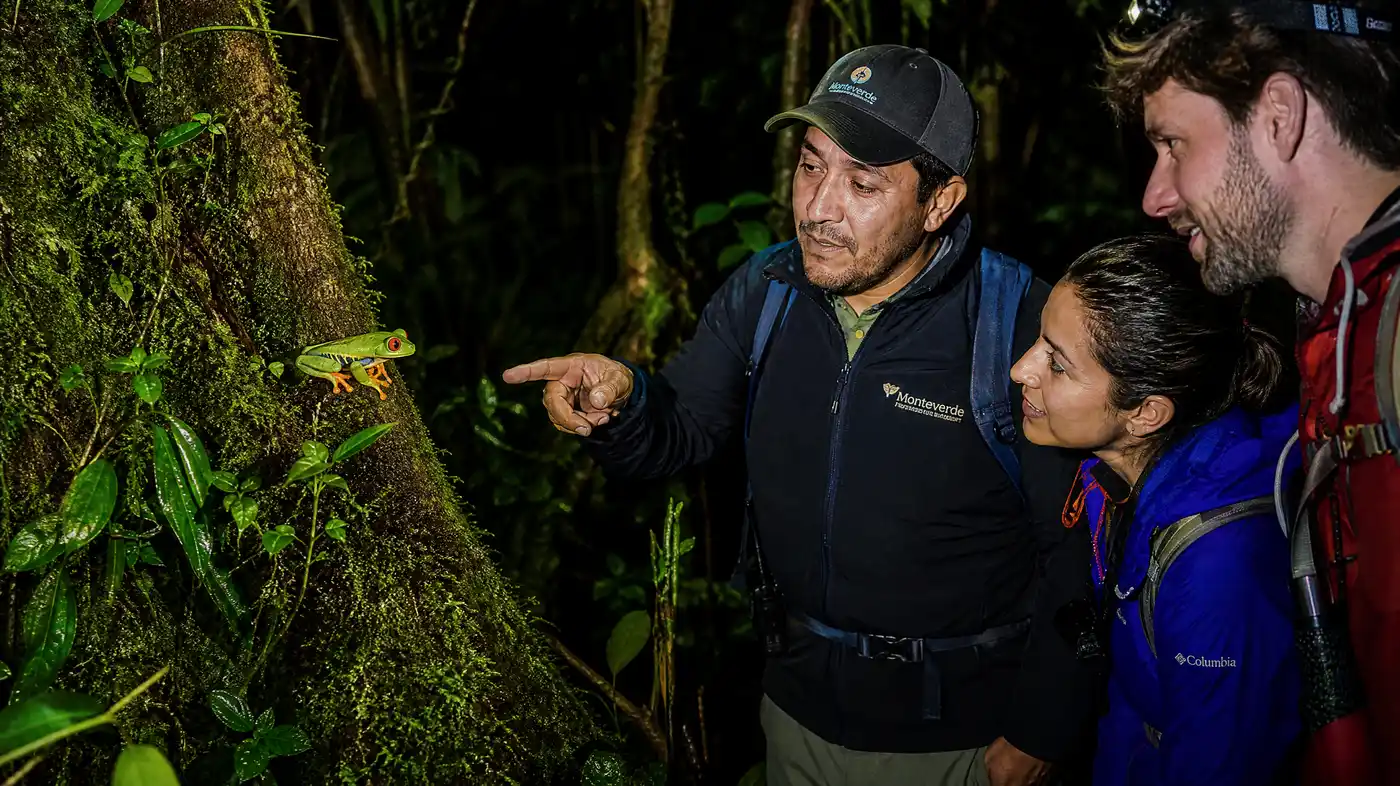
The sounds change first. Cicadas and katydids start up an electrical buzzing that fills your ears. Your guide issues small flashlights, though the best guides tell you to keep them turned off until they locate an animal with their own specialized beam. Sweeping five amateur flashlights around wildly just scares the canopy dwellers into hiding. If you want to know what else wanders around in larger reserves nearby, read our breakdown of Monteverde night tour animals to see what species prefer agricultural edges over dense cloud forest.
The edge habitat of a coffee farm actually attracts specific creatures. Plantation borders often have wild avocado trees, guarumo, and fruit-bearing ficus that draw animals out from deep forest cover. On any given night, you might find:
- Sleeping birds: Orange-bellied trogons, motmots, and toucanets tuck their heads into their feathers on low branches, looking like round, motionless balls of color.
- Tree frogs: Red-eyed tree frogs and masked tree frogs gather near drainage pools and small creeks along the farm edges.
- Mammals: Kinkajous, two-toed sloths, and white-nosed coatis actively forage in the fruit trees overhead once darkness settles.
- Invertebrates: Orange-kneed tarantulas waiting at the mouth of silk-lined burrows, alongside whip scorpions and massive walking sticks.
A night hike on a farm-forest border is distinct from walking the high-elevation reserves. The canopy is generally lower, the ground is flatter, and the walking pace is leisurely. You will rarely cover more than 1.5 kilometers over the course of two hours.
Handling Weather: Monteverde Coffee and Night Tour Rain Realities
It rains in Monteverde. A lot. It mist-rains, it pours, and sometimes it blows sideways on winds clocking 40 kilometers an hour. A passing storm should never cancel your plans for a monteverde coffee and night tour rain outing unless there is active lightning or high winds snapping large tree branches.
Note: Ponchos handed out by tour desks rip instantly on low brush. Bring a real waterproof shell with taped seams, because agricultural fields have zero overhead cover when a cloud bursts.
Rain actually changes the night tour in fascinating ways. Heavy moisture brings amphibians out of hiding immediately. The chorus of glass frogs, hourglass frogs, and dinging rain frogs gets remarkably loud after a downpour. Sloths tend to curl up into wet clumps high in the forks of trees during hard rain, but snakes, particularly side-striped palm pit vipers, often position themselves openly on broad wet leaves near the trail to ambush hunting frogs.
During the coffee and chocolate portions, rain is barely an inconvenience. Roasting sheds, grinding stations, and tasting patios are covered by corrugated tin roofs. Hearing the roar of tropical rain drumming on a metal roof while drinking freshly brewed dark roast from a clay mug is honestly one of the coziest feelings in the entire mountain district.
Book your monteverde night tour experience:
Comparing Top Operators for a Monteverde Coffee Chocolate and Night Tour
Several local family farms and established reserves run this combination. While each covers coffee, cacao, and nocturnal wildlife, their execution and group sizes differ considerably. Some lean heavily into agricultural education, while others emphasize the night walk component on expansive secondary forest tracks.
Don Juan Monteverde is perhaps the most famous, running a slick, highly organized operation with extensive covered walking paths. It is accessible, predictable, and great for travelers with limited mobility, though group sizes can swell to 12 or 14 people during high season. Finca El Trapiche takes a more rustic, folkloric route, using oxcarts and focusing heavily on traditional lifestyle alongside coffee culture.
Then there are smaller operations like Finca La Bella or Cafe Monteverde, which emphasize regenerative agriculture, sustainability, and small-group conservation. For a wider view of how stand-alone wildlife walks compare across the area, check our guide to the best night tours in Monteverde before locking in your reservation.
| Tour Name / Farm | Approx Duration | Typical Price (Adult) | Key Focus | Trail Condition |
|---|---|---|---|---|
| Don Juan 3-in-1 Combo | 2.5 to 3 hours | $45 - $52 | Chocolate making & smooth paths | Paved, highly accessible |
| El Trapiche Combo Tour | 3 hours | $42 - $48 | Sugar cane processing & culture | Packed dirt, gravel |
| Finca Two Rivers Night & Coffee | 3.5 hours | $50 - $58 | Deep wildlife focus & creek trails | Uneven dirt, muddy when wet |
| Local Cooperative Combo | 3 hours | $38 - $45 | Fair-trade farming & rustic night walk | Natural forest paths |
Prices usually include pick-up and drop-off from central Santa Elena accommodations. If you stay further out along the road toward San Luis or near the entrance of the cloud forest reserve, an extra $5 to $10 transport fee might apply.
Packing and Preparation for the Coffee Night Tour Monteverde
Preparing for an afternoon that bleeds into night requires two distinct sets of gear thoughts. At 2:30 PM, you will likely be hot, swatting gnats under bright sunshine. Two hours later, the temperature drops down toward 14 degrees Celsius (around 57 Fahrenheit) with damp wind blowing off the Continental Divide.
Dressing in functional layers is the only sane way to handle this swing. Here is a practical checklist for the afternoon:
- Sturdy closed-toe footwear: Hiking boots or running shoes with deep tread. Red volcanic soil turns into slick clay within three minutes of rainfall.
- Dark or neutral long pants: Protects your legs from stray coffee branch scratches, biting ants, and evening mosquitoes near water puddles.
- Breathable rain jacket: A packable shell you can stuff into a daypack during the warm coffee processing walk.
- Insect repellent: Apply it before you leave your lodge, never spray it directly on plants or near frogs during the hike.
- A compact dry bag or plastic zip pouch: Essential for keeping your phone, camera, or wallet bone dry during unexpected downpours.
Do not bother bringing high-powered tactical flashlights. The farm or guide service supplies standard flashlights suited to nocturnal searches. Bright personal headlamps often shine directly into other people's eyes or blind animals that have sensitive night vision.
Tipping is customary for guides who manage to balance entertaining storytelling during the chocolate workshop with sharp-eyed spotting on the night trail. Around 3,000 to 5,000 Costa Rican Colones ($6 to $10) per person is standard if your guide gave you a great experience.
Frequently Asked Questions about monteverde coffee chocolate and night tour
Is this tour suitable for young children?
Yes, it is one of the best family outings in the area. Children stay engaged because the chocolate making is hands-on and they get to eat warm candy, while the night walk offers an easy treasure hunt feel without exhausting physical hikes.
Will we see sloths on the night walk portion?
Sloths are frequently spotted along forest-farm boundaries because of cecropia trees, but they are wild animals. Sightings can never be guaranteed on any single night. You are much more likely to spot sleeping birds, tree frogs, and unusual nocturnal insects.
Can I do this tour if I do not drink coffee?
Absolutely. The agricultural portion explains the social and economic history of Costa Rica beyond just drinking the product. You can skip the coffee tasting and dive straight into the chocolate, cane juice, and fresh tropical fruit samples.
Quick Reference
- Typical start: 2:30 PM to 3:00 PM
- Duration: 2.5 to 3.5 hours
- Cost: $40 to $58 per adult
- Key gear: closed shoes, rain jacket, long pants
Book your monteverde night tour experience:
Is It Worth It?
If you have three or four days in Monteverde, bundling these three activities into one afternoon saves you daytime hours for longer canopy hikes and suspension bridges. It is social, aromatic, and grounding. Standing under a cluster of broad banana leaves in the dark, chewing on roasted cacao nibs while your guide shines a flashlight on a tiny, emerald-colored glass frog sleeping under a leaf - that is the exact texture of Monteverde that travel brochures fail to capture. Book an afternoon slot, pack a reliable raincoat, and leave your dinner plans open until you finish tasting everything on the farm.
Read more about monteverde night tour.